Beta-Particle Transport and Thermalization in Kilonova Ejecta with Detailed Atomic Microphysics
Z. L. Andalman, C. L. Fryer, C. J. Fontes, M. R. Mumpower, & R. T. Wollaeger
preprint • 2026
Abstract
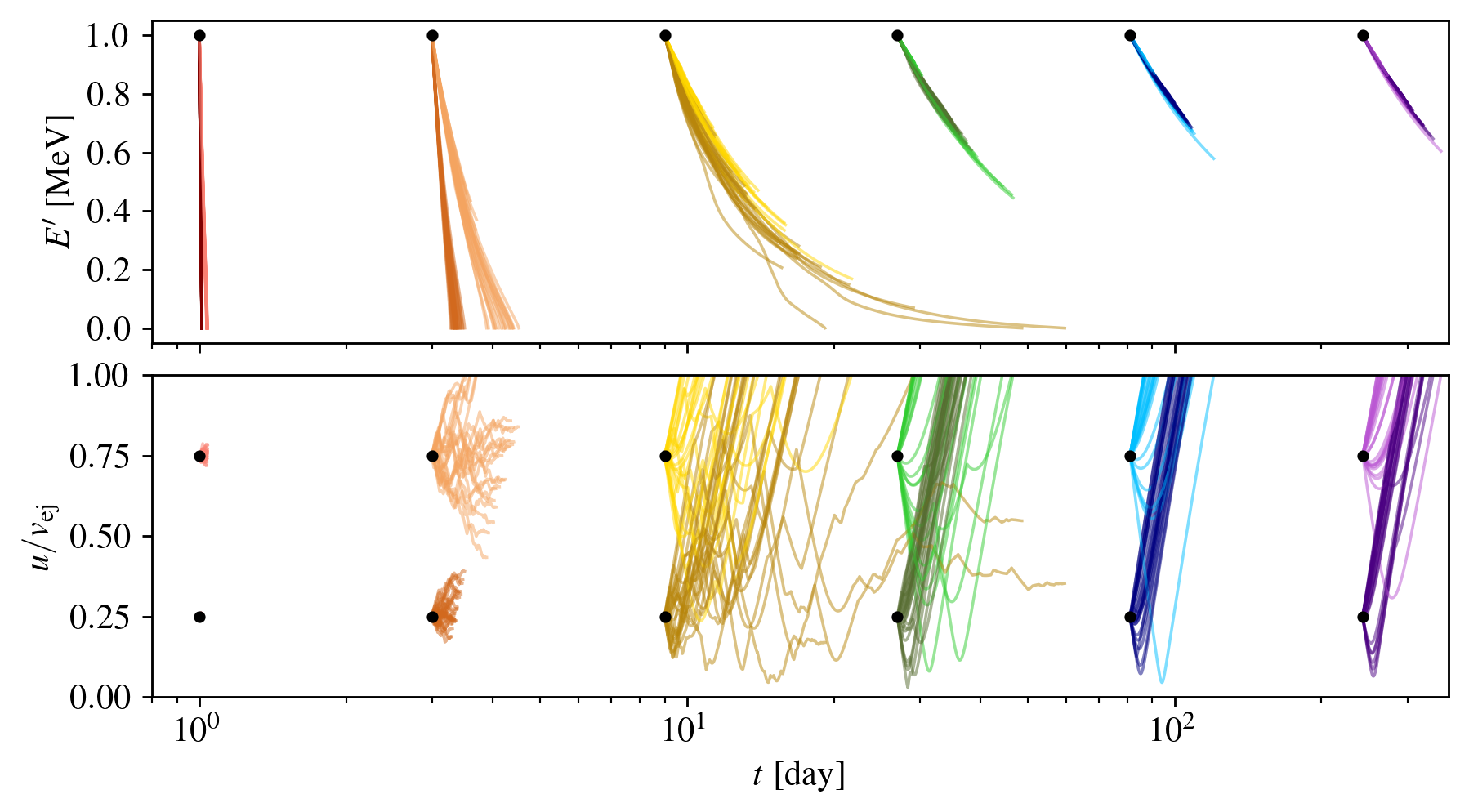
When two neutron stars collide, they eject material containing heavy nuclei formed by the rapid neutron capture process (r-process). As these nuclei decay, they power a bright optical/near-infrared transient known as a kilonova (KN). Modeling KN emission is a complex problem involving atomic opacities, radiation transport, and heating powered by the thermalization of radioactive decay products like gamma-rays, alpha-particles, and beta-particles. For heating by gamma-rays, many KN modeling codes do full radiation transport calculations. However, heating by alpha- and beta-particles relies on simplified descriptions of collisions and transport, and remains an important source of uncertainty in KN models. In this paper, we study the thermalization and transport of beta-particles. To study thermalization, we use evaluated atomic physics data to estimate per-species contributions to energy deposition, scattering, and electron impact ionization, which we make available online. To include non-local effects, we develop a fully relativistic framework for charged particle transport in a spherically symmetric, homologously expanding ejecta, considering two limiting magnetic-field geometries. Non-local energy deposition and escape reduce thermalization efficiency, especially in the innermost and outermost ejecta, lowering the ejecta temperature and ionization state compared to local deposition models. Coulomb scattering partially offsets these effects by trapping particles at intermediate times. Ionization by secondary electrons significantly enhances the overall ionization rate. We provide analytic prescriptions for the spatially dependent thermalization efficiency for use in future light-curve calculations. Our results demonstrate that evaluated atomic data and charged-particle transport should be incorporated into the next generation of KN models.
Data description
Per-species stopping, transport, and electron impact ionization (EII) cross sections for beta-particle transport in kilonova ejecta. We also provide combined cross sections using our strong r-process abundance pattern at 30 days post-merger. The data are adapted from the Evaluated Electron Data Library (EEDL), distributed as part of the Electron Photon Interaction Cross Sections (EPICS) 2023 database (Cullen 2017). The original EPICS 2023 data are available at https://www-nds.iaea.org/epics/.
 go to arXiv
 open PDF
 download data