Nozzle Shocks, Disk Tearing, and Streamers Drive Rapid Accretion in 3D GRMHD Simulations of Warped Thin Disks
N. Kaaz, M. T. P. Liska, J. Jacquemin-Ide, Z. L. Andalman, G. Musoke, A. Tchekhovskoy, & O. Porth
ApJ • 2023
Abstract
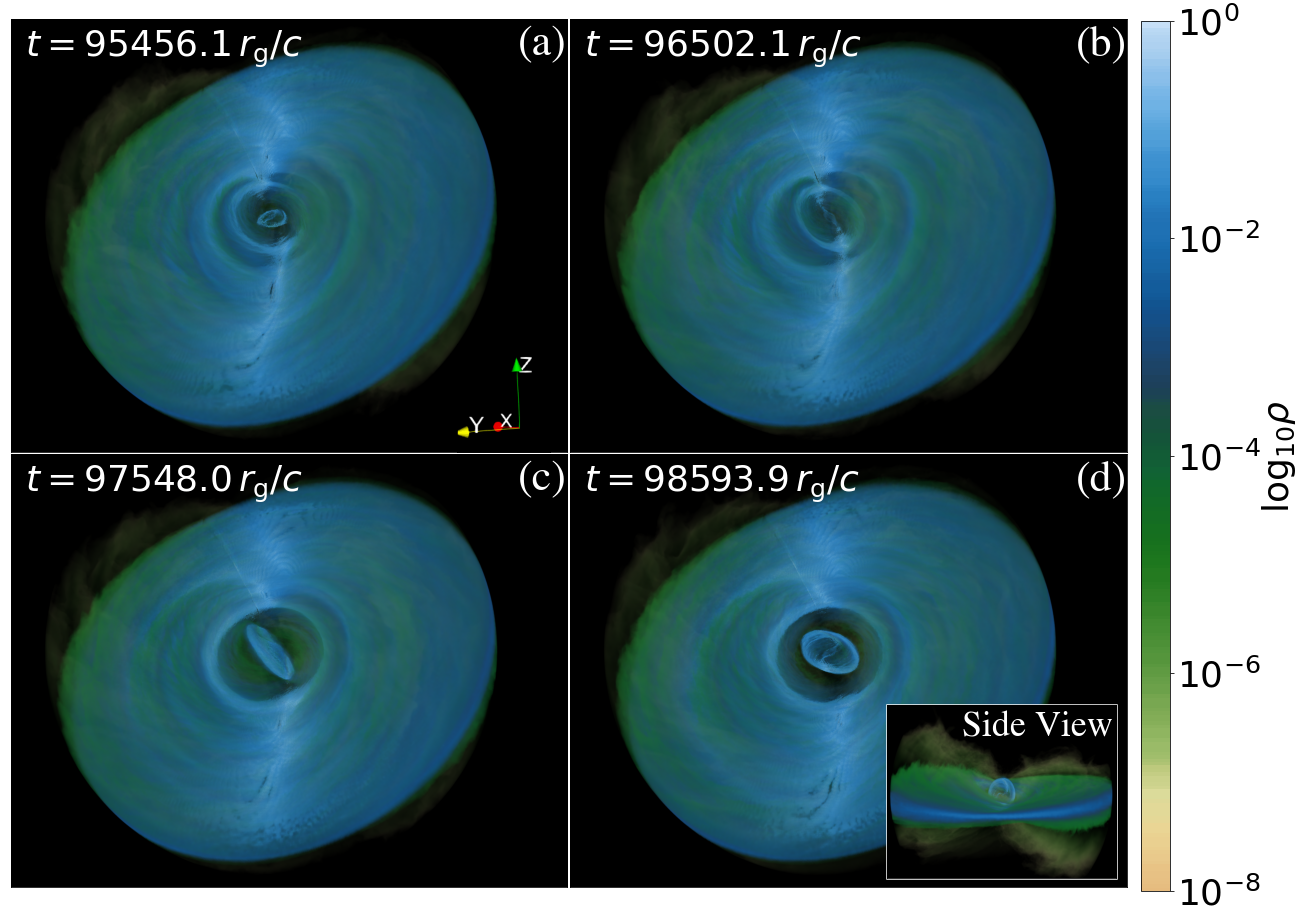
The angular momentum of gas feeding a black hole (BH) may be misaligned with respect to the BH spin, resulting in a tilted accretion disk. Rotation of the BH drags the surrounding spacetime, manifesting as Lense-Thirring torques that lead to disk precession and warping. We study these processes by simulating a thin (h/r = 0.02), highly tilted (T = 65 deg) accretion disk around a rapidly rotating (a = 0.9375) BH at extremely high resolutions, which we performed using the general-relativistic magnetohydrodynamic code H-AMR. The disk becomes significantly warped and continuously tears into two individually precessing subdisks. We find that mass accretion rates far exceed the standard alpha-viscosity expectations. We identify two novel dissipation mechanisms specific to warped disks that are the main drivers of accretion, distinct from the local turbulent stresses that are usually thought to drive accretion. In particular, we identify extreme scale height oscillations that occur twice an orbit throughout our disk. When the scale height compresses, "nozzle" shocks form, dissipating orbital energy and driving accretion. Separate from this phenomenon, there is also extreme dissipation at the location of the tear. This leads to the formation of low-angular momentum "streamers" that rain down onto the inner subdisk, shocking it. The addition of low-angular momentum gas to the inner subdisk causes it to rapidly accrete, even when it is transiently aligned with the BH spin and thus unwarped. These mechanisms, if general, significantly modify the standard accretion paradigm. Additionally, they may drive structural changes on much shorter timescales than expected in alpha-disks, potentially explaining some of the extreme variability observed in active galactic nuclei.
 go to journal
 go to arXiv
 open PDF