The MAGE Project: Size Evolution and Disk Formation in Massive Galaxies at Cosmic Dawn
Z. Yao, A. Dekel, R. Teyssier, R. S. Somerville, N. Mandelker, Z. L. Andalman, U. P. Steinwandel, & Z. Li
preprint • 2026
Abstract
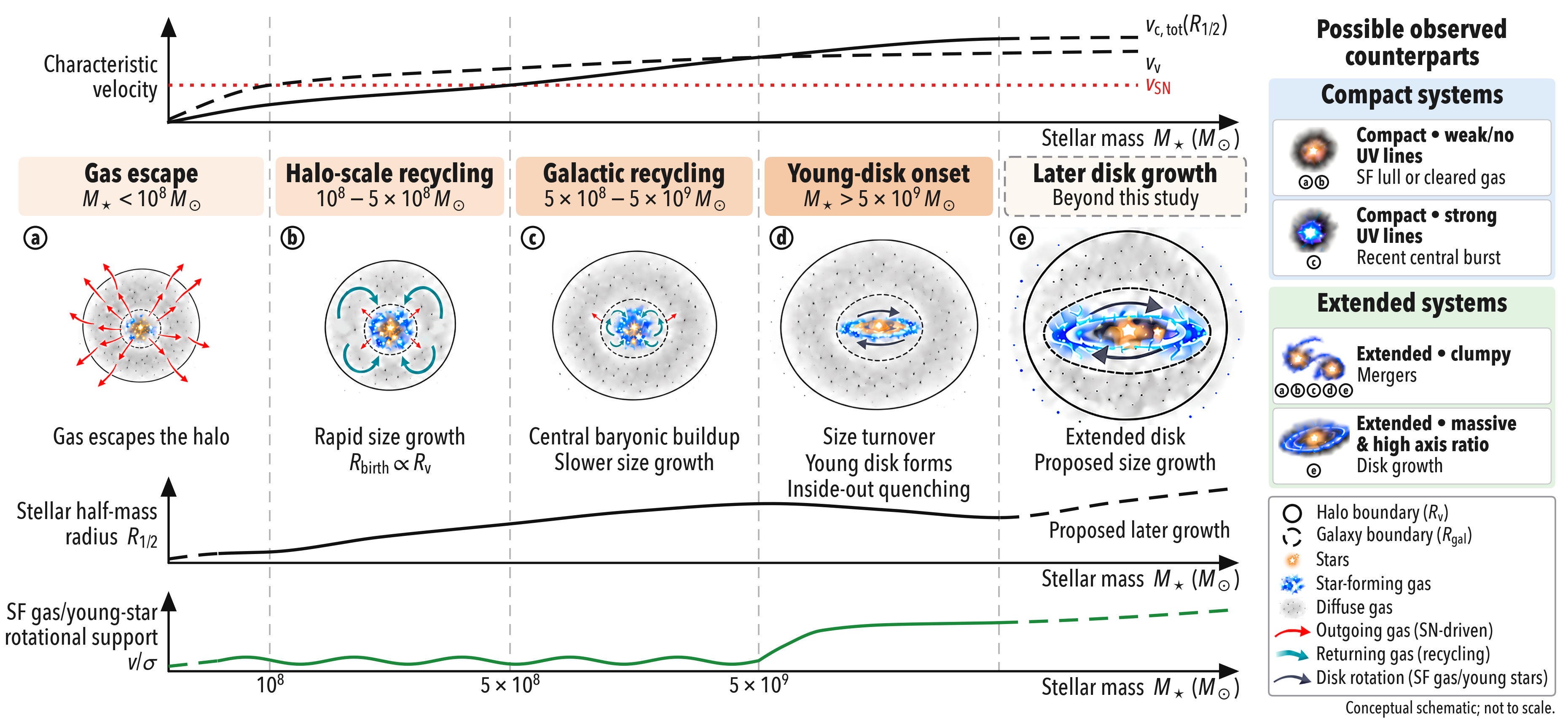
We investigate size evolution and disk formation with a new suite of eleven cosmological zoom-in simulations, Massive Assembly of Galaxies in the Early universe (MAGE), run with RAMSES at ~10pc resolution until z~9. The target galaxies span stellar masses of M~2e8-3e10 Msol at z=9. The stellar half-mass radius grows steeply with stellar mass at low masses, turns over near M~5e9 Msol, and evolves weakly with redshift. The intrinsic UV sizes in MAGE overlap the compact end of observed distributions, including the compact strong-line systems, but not the more extended population at z>9. Dust, PSF-limited size measurements, and our overdense environments may contribute to this offset. In the simulations, stars dominate the mass within the half-mass radius above M~5e8 Msol, where the central circular speed exceeds a characteristic stellar-feedback scale. Outflows are then increasingly retained within the galaxy, consistent with gas recycling on galactic rather than halo scales, which sustains central gas supply and drives a compaction-like central buildup. The turnover in size at M~5e9 Msol coincides with rapid growth of rotational support to v/sig~1.5-3 in star-forming gas and stars younger than 10Myr, as the central circular speed exceeds the halo virial speed, which the star-forming gas velocity dispersion tracks. The subsequent low central gas fraction, declining central star formation, and younger outskirts suggest the onset of inside-out quenching.
 go to arXiv
 open PDF